Perforated aluminium panels are one of the most requested products we make at Foshan Third Aluminium. Architects specify them for facades and sunscreens, interior designers use them for ceilings and room dividers, and contractors choose them because they are light, straightforward to install and last for years with very little upkeep.
This guide explains what perforated aluminium panels are, why aluminium is such a good material for them, the hole patterns and finishes available, and where they are used.
What is a perforated aluminium panel?
A perforated aluminium panel is a sheet of aluminium that has been punched or cut with a pattern of holes. The holes can be a simple repeating grid of circles, a geometric pattern such as hexagons or slots, or a fully custom design taken from your drawing.
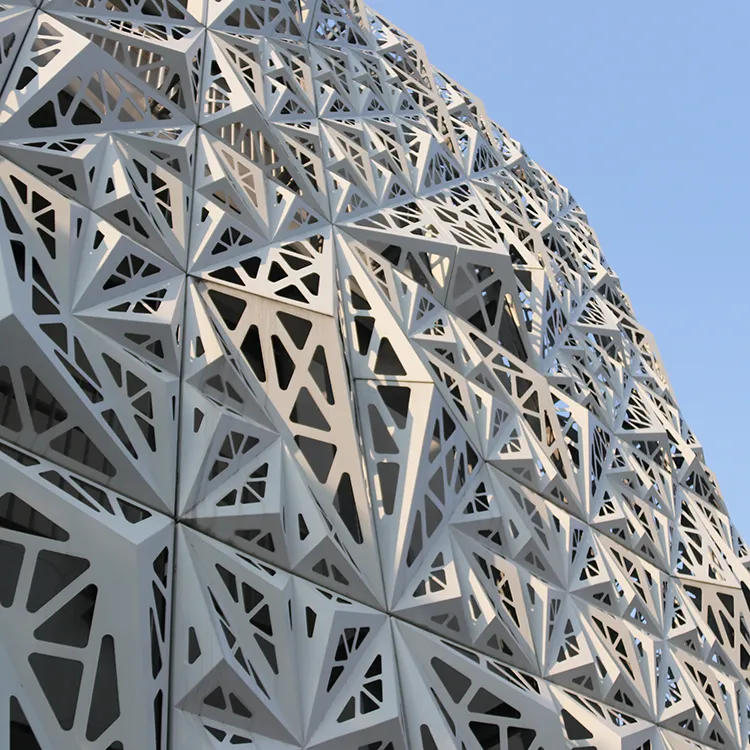
The pattern decides how the panel behaves. Larger holes and tighter spacing let more light and air through; smaller holes and wider spacing give more privacy and shade. That balance between solid and open is what makes perforated panels so useful: one material can be a screen, a sunshade, a ventilated cladding layer or a decorative feature, depending on how it is designed.
Why choose aluminium for perforated panels?
Perforated panels can be made from several metals, but aluminium is the most common choice for architectural work, and for good reason.
- Lightweight. Aluminium is far lighter than steel, which means lighter support structures, easier handling on site and less load on the building.
- Does not rust. Aluminium forms a natural oxide layer that protects it from corrosion. Unlike untreated steel, it will not rust and stain the surrounding facade.
- Takes a durable coating. Aluminium bonds well with PVDF and PE coatings, so the finish stays put and keeps its colour.
- Easy to work. Aluminium sheet cuts, punches, folds and bends cleanly, so panels can be formed with returns, flanges and curves to suit the fixing system.
- Recyclable. Aluminium can be recycled again and again, which matters on projects with sustainability targets.
Put together, these qualities make perforated aluminium suitable for both interior and exterior use, and for projects where the panels need to look good for a long time.
Hole patterns and design options
The perforation pattern is where a project gets its character. We can produce:
- Round and long round (slotted) holes
- Square, rectangle and diamond
- Hexagon and triangle
- Cross, pentagram and plum blossom
- Oval, fish scale, long waist and drum shapes
- Custom patterns made from your own drawing
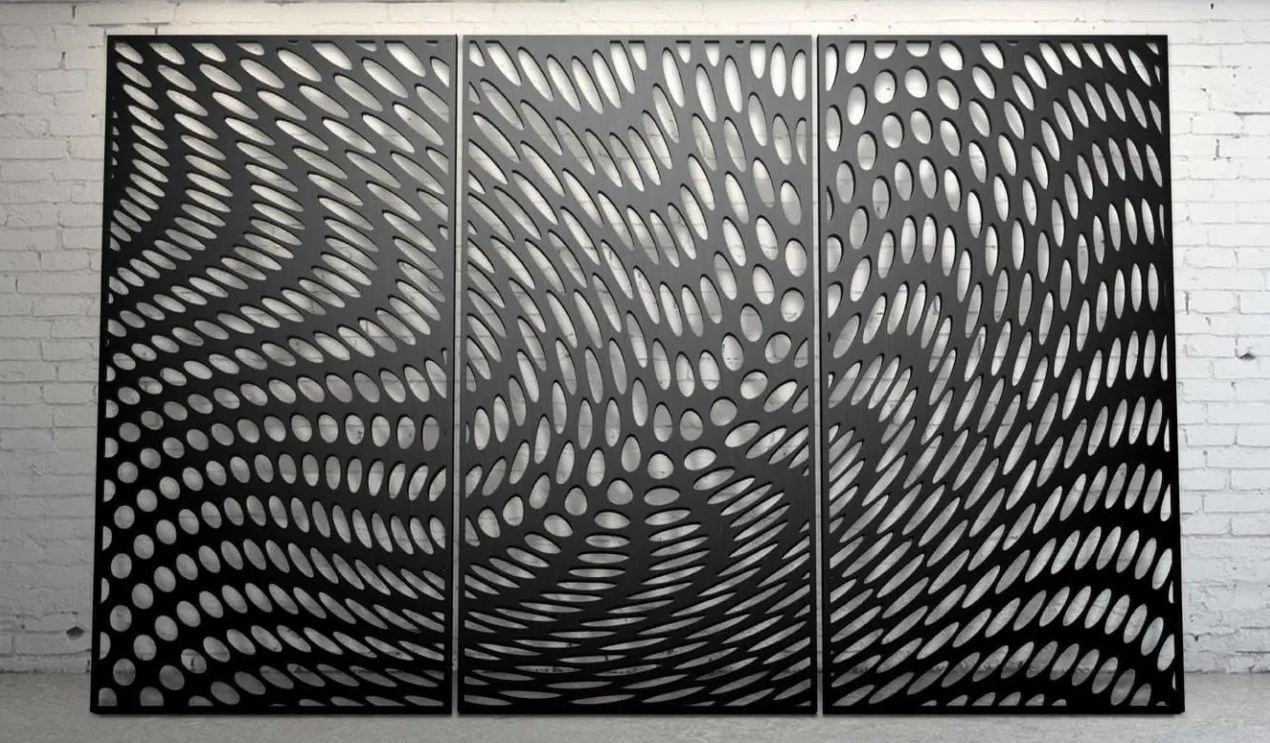
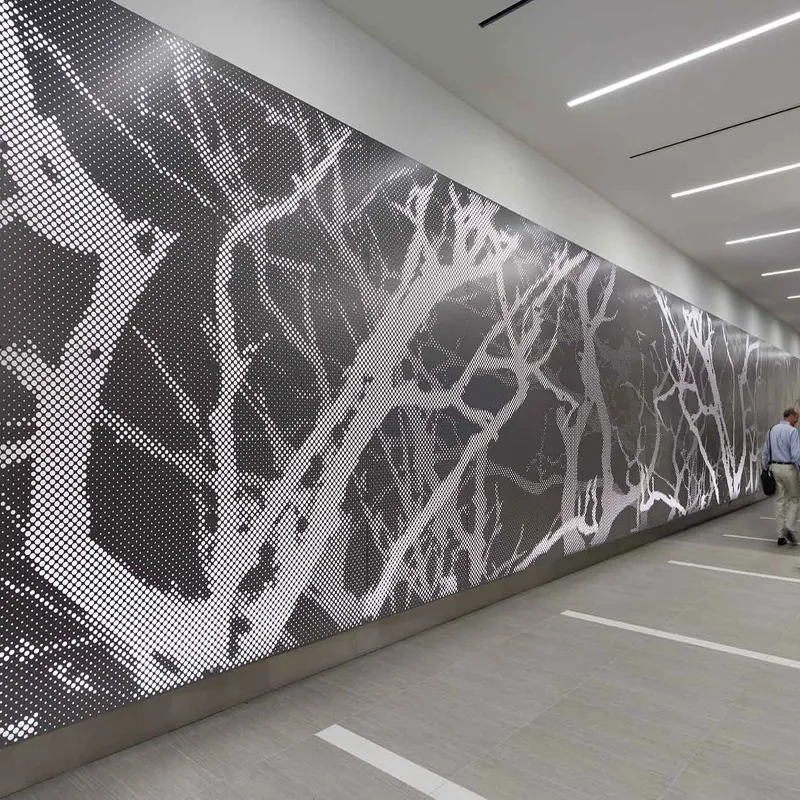
Hole size, spacing and the overall open area are all set to your design. A dense pattern of small holes reads as a smooth, almost solid surface from a distance, while large or irregular perforations create a bold graphic effect. Patterns can also be graded across a panel, or across a run of panels, to build up an image or a flowing shape, like the oval perforations in the panels at the top of this article.
For more artistic designs such as laser-cut motifs and feature walls, see our decorative panels.
Finishes and colours
The finish protects the panel and sets its appearance, so it is worth choosing carefully. We offer two coating systems.
PVDF coating
PVDF (polyvinylidene fluoride, often called fluorocarbon coating) is the premium choice for exterior work. It resists UV, weathering and pollution, and holds its colour well over time. Our PVDF finish is guaranteed for 20 to 25 years, which makes it the right option for facades, sunscreens and any panel exposed to direct sunlight and rain.
PE coating
PE (polyester) coating is a cost-effective finish that suits interiors and less exposed areas. Our PE finish is guaranteed for 10 to 15 years. It is a sensible choice for ceilings, internal partitions and decorative work where the panels are protected from the weather.
Colours
Panels can be supplied in any colour, normally referenced to the RAL colour chart or matched to a sample you send us. That means panels can be matched to window frames, curtain walling or a brand colour.
If you would like to read more about coating options and how they are tested, our article on aluminium veneer coating selection and colour durability goes into more detail.
Applications
Perforated aluminium panels turn up across almost every type of building. The most common uses are:
Building facades and cladding
Perforated panels are widely used as an outer skin on commercial buildings, car parks and public buildings. They give a building a distinctive look, hide services and structure behind them, and still allow light and air through to the wall or windows beneath.
Sunshades and solar screening
Fixed in front of glazing, perforated panels cut glare and solar heat while keeping a view out. The hole pattern can be tuned so the screen is more open where views matter and more solid where shade is needed.
Ceilings
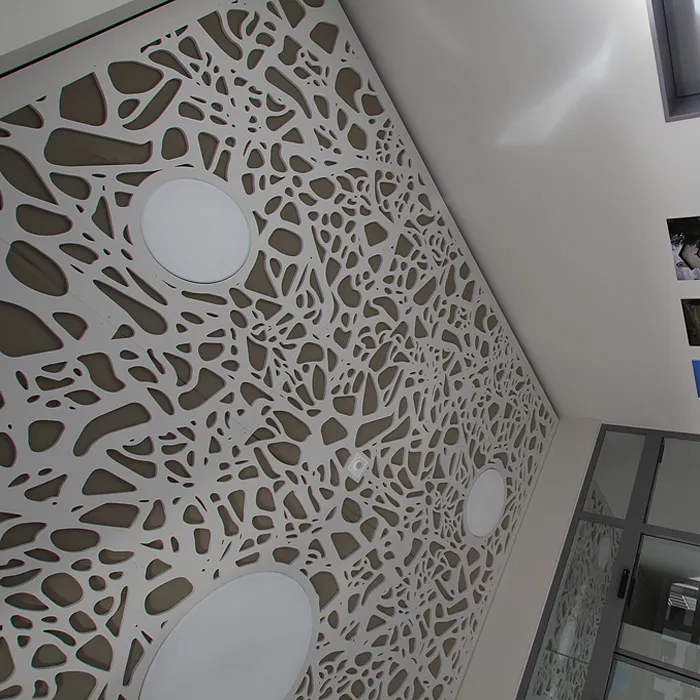
Perforated ceiling panels give interiors a clean, continuous finish while leaving space for lighting, ventilation and services above. Cut-outs can be designed around light fittings, as in the ceiling below.
Room dividers and interior screens
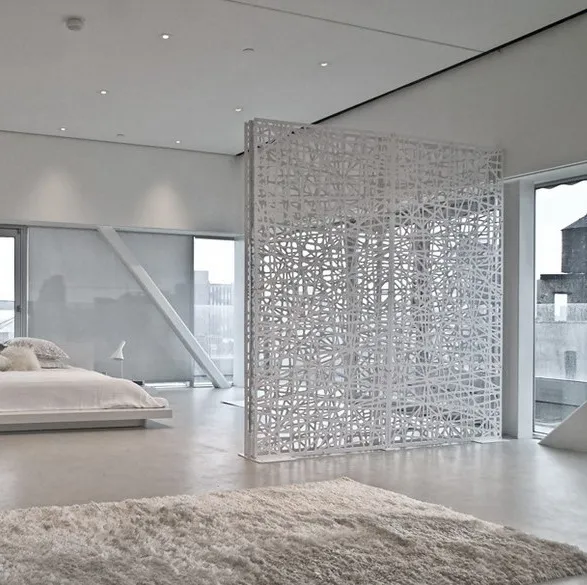
In homes, hotels, offices and shops, perforated screens divide a space without closing it off. Light still passes through, and the pattern becomes a design feature in its own right.
Balustrades and fencing
On balconies, stairs, walkways and boundaries, perforated aluminium infill panels add privacy and a finished look, and because aluminium does not rust they are well suited to outdoor use.
Feature walls and signage
Graded and custom patterns can form images, logos and lettering, making perforated panels a popular choice for reception areas, retail interiors and building entrances.
Specifications at a glance
| Specification | Detail |
|---|---|
| Alloys | AA1100, AA3003, AA3014, AA5005, AA5015, AA6063 |
| Thickness | 1 - 15 mm |
| Panel size | Custom, up to 1,500 x 4,000 mm |
| Finish | PVDF or PE |
| Colours | Any RAL colour, or matched to a sample |
| Minimum order | 200 kg |
| Delivery | 30 days from payment |
How to order perforated panels
Every panel we make is produced to order, so the best place to start is with a drawing. Send us:
- Drawings or sketches showing panel sizes and the perforation pattern you want
- The thickness and alloy, if specified, or tell us where the panels will be used and we can advise
- Your preferred finish (PVDF or PE) and colour reference
- Quantities and the delivery destination
Each panel is wrapped in clear or blue PVC film to protect the surface in transit, and delivery is 30 days from payment.
Find full details on our perforated aluminium panels page, or contact us with your drawings for a quotation.